


Loose, Fast and Full of Feeling: My Demo at Taunton Creative Club

Last week, I had the pleasure of delivering a live urban sketching demonstration for around 12–15 members of the Taunton Creative Club, exploring the loose, expressive approach to drawing and painting that has become such a big part of my own work.
I wanted the session to be about much more than simply showing people how I draw. For me, the real challenge is helping people understand how to let go of the desire to make a perfect picture and instead create something that feels personal, spontaneous and alive.
I demonstrated two paintings, working from source photographs to show how I approach a scene when I'm developing a loose watercolour sketch.
True urban sketching happens on location.
Working from a photograph is useful for demonstrating technique, but being there in the street changes everything. You experience the sounds, movement, weather, light, people and atmosphere of a place. Those things inevitably influence the marks and colours you make. I began with my continuous line approach, using a pen to move quickly around the scene. Rather than carefully constructing every building and checking every perspective, I allowed the line to wander, overlap and occasionally go wrong.
And that's exactly the point. The faster you work, the less time you have to worry about perfection.
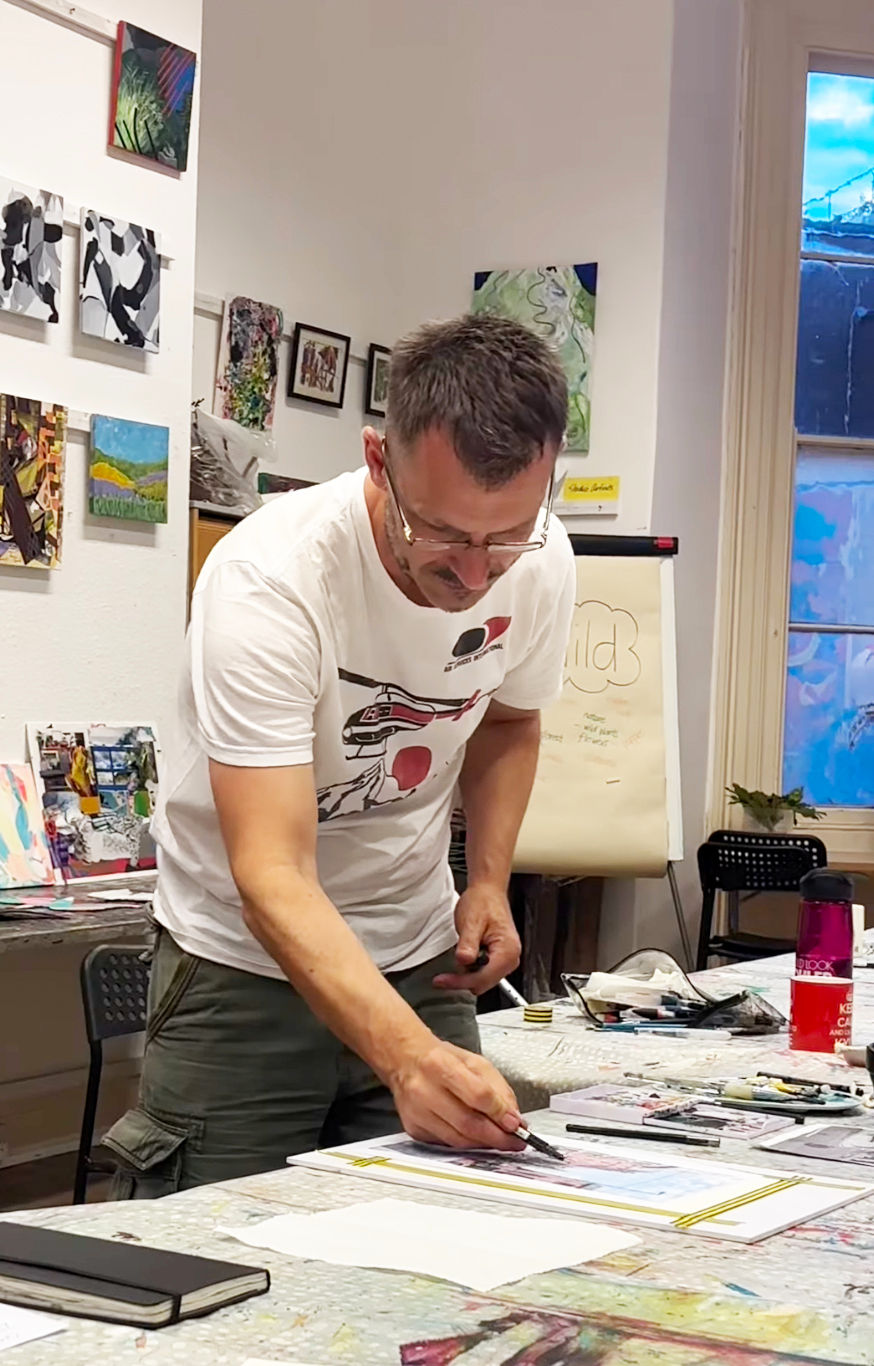
One of the key messages I wanted to get across was that an urban sketch doesn't need to be a photographic representation of what you see.
In fact, I think trying to make it too accurate can often take the life out of a drawing.
Instead, I encouraged the group to think about creating a personal response to a place.
A loose line, an exaggerated building, an unexpected mark or a splash of colour can tell us far more about the artist's experience of a scene than a technically perfect drawing ever could.
Once the line was established, I moved onto the watercolour.
This is where I really pushed the looseness and began using bold, expressive areas of colour.

Rather than simply copying the colours from the photograph, I thought back to the day I had actually taken the original reference photographs.
It had been hot. That affected how I remembered the scene — and, consequently, how I wanted the painting to feel. The colours became warmer, stronger and more expressive. I wasn't trying to reproduce exactly what was in front of the camera. I was trying to capture my memory and emotion of being there.
That's something I think is really important in urban sketching: colour doesn't just describe a place; it can describe how that place felt.
Working this quickly inevitably creates mistakes, overlaps and unexpected marks.
But rather than correcting everything, I encouraged the group to embrace them.
A splash that lands in the wrong place might become part of the building. A line that wanders off might add energy. A colour that bleeds into another can create something far more interesting than anything you could have planned.
For me, that's where the excitement comes from.
The aim isn't perfection. It's personality.
By working quickly and intuitively, the finished sketch becomes a record of the artist's experience rather than simply a copy of a photograph.
It was a great session with a really engaged group, and I loved being able to demonstrate the process from those first loose pen marks through to the final expressive washes. And hopefully, everyone left with a slightly different view of what an urban sketch can be loose, fast, imperfect and, above all, personal.


Comments